
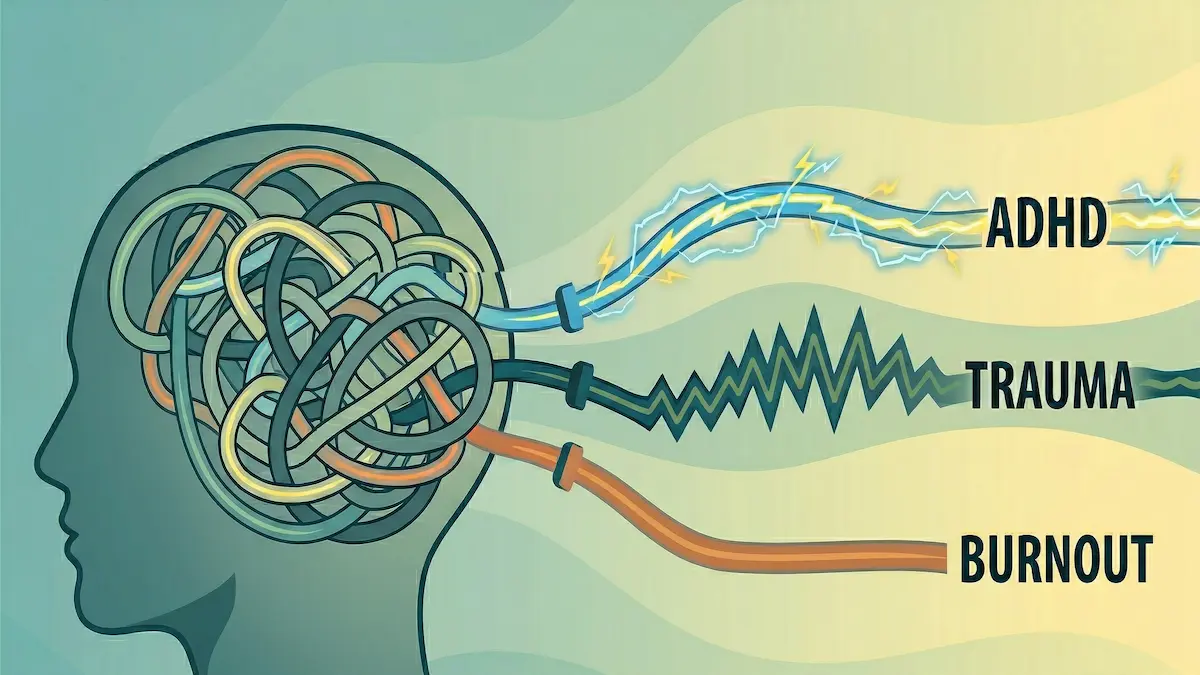
Why Can’t I Focus? ADHD, Trauma, or Burnout

Do I have ADHD? Why can’t I focus? Feeling constantly overwhelmed, exhausted, or unable to focus can be an incredibly isolating experience. You might spend hours scrolling through articles and social media, trying to put a name to what you are feeling. So many are asking, “why can’t I focus” Is it a neurodevelopmental condition? Are you carrying the heavy weight of past events? Or are you simply exhausted from the demands of daily life?
When you struggle to complete tasks, manage your emotions, or keep your thoughts organized, it is natural to look for answers. Because the symptoms of ADHD, trauma, and burnout overlap so heavily, many people find themselves feeling confused. This overlap often leads to self-diagnosis or misdiagnosis, leaving individuals without the specific support they truly need to thrive.
Understanding the root cause of your struggles is the first step toward finding relief. You are not alone in this journey.
Table of Contents
Defining the Trio
To understand why these three conditions look so similar, we first need to define what each one actually is. While they might share outward symptoms, their origins are very different.
| Feature | ADHD | Trauma | Burnout |
|---|---|---|---|
| Onset | Childhood/Always been there | After a specific event or period | Gradual/Follows high stress |
| Primary Driver | Dopamine regulation | Hypervigilance/Safety | Energy depletion |
| Rest’s Effect | Doesn’t “fix” it | May feel “unsafe” | Improves symptoms over time |
| Consistency | Consistent struggles over time | Triggers cause fluctuations | Sporadic |
Why They Look the Same
If you place three people in a room, one with ADHD, one with untreated trauma, and one experiencing severe burnout, they might all struggle with the exact same tasks. Here is why these conditions mirror each other so closely.
Executive Dysfunction
Executive function is the brain’s management system. It helps you plan, organize, and complete tasks. All three conditions severely impact this system. An individual with ADHD struggles with executive function due to brain chemistry. Someone with trauma may struggle because their brain is occupied with basic survival. A person with burnout simply lacks the energetic resources to plan and execute tasks.
Memory Issues
Forgetfulness is a hallmark of all three experiences. ADHD makes working memory naturally weaker, making it easy to forget instructions or lose your keys. Trauma impacts the hippocampus, the brain area responsible for memory storage, causing gaps in memory or frequent forgetfulness. Burnout causes cognitive fatigue, making it incredibly difficult for your brain to retain new information.
Emotional Dysregulation
Big emotions are a shared struggle. People with ADHD often feel emotions intensely and have a hard time filtering them. Not to mention, sometimes ADHD can get worse because of antidepressants. Trauma leaves the nervous system highly reactive, leading to sudden anger or tears. Burnout strips away your emotional reserves, meaning even a small inconvenience can trigger a massive emotional reaction.
Sleep Disturbances
Getting a good night of rest is a challenge across the board. ADHD can make it hard to quiet your mind at night. Not to mention, sometimes your ADHD medications could also be making you tired. Trauma often brings nightmares or hypervigilance that prevents deep sleep. Burnout disrupts your natural circadian rhythms due to elevated stress hormones like cortisol, leaving you tired but wired.
How to Tell the Difference
While the symptoms overlap, you can look for specific clues to help identify the root cause of your struggles. Here are three ways to check what might be happening beneath the surface.
The History Check
Look at the timeline of your symptoms. ADHD is a lifelong condition. If you have ADHD, you likely experienced symptoms during childhood, even if you were able to mask them. Trauma symptoms usually begin after a specific distressing event or a period of prolonged adversity. Burnout is directly tied to a period of intense, unrelenting stress, often developing over months or years in a demanding environment.
The Environment Check
Consider where your symptoms appear. ADHD affects you in every environment, at work, at home, and on vacation. Trauma symptoms can appear anywhere, but they are usually activated by specific environmental cues that remind your nervous system of past events. Burnout is often tied to a specific environment; if you take a long break from work or your stressors, burnout symptoms typically begin to improve.
The Trigger Check
Pay attention to what makes your symptoms worse. With ADHD, symptoms often flare up when a task is understimulating or repetitive. For trauma, symptoms spike when you encounter a trigger that mimics a past danger, leading to a fight, flight, or freeze response. With burnout, symptoms worsen when you are asked to take on one more task, leading to a feeling of complete overwhelm.
When Conditions Overlap
One of the most complex parts of mental health is comorbidity, which means having more than one condition at the same time.
Not Mutually Exclusive
Having ADHD does not protect you from trauma or burnout. In fact, people with ADHD are often more vulnerable to both. You can absolutely have ADHD, carry trauma, and be experiencing burnout all at once. Untangling these overlapping issues takes patience, self-compassion, and professional support.
The Cycle of ADHD and Burnout
Many adults with ADHD find themselves stuck in a painful cycle. Because living with ADHD requires extra effort to navigate a world built for neurotypical brains, individuals often push themselves too hard to keep up. This constant masking and overworking drain their energy reserves, frequently leading to severe burnout. Understanding this cycle is the first step toward breaking it.
Moving Forward with Professional Support
Trying to figure this out on your own can be overwhelming. You do not have to carry this burden alone. Seeking a professional psychiatric evaluation is the safest and most effective way to gain clarity.
A compassionate psychiatrist can help you review your history, untangle your symptoms, and provide an accurate diagnosis. At IN Focus First, we are here to support you in a welcoming and non-judgmental environment. We offer a convenient and accessible way to get an accurate diagnosis and receive the appropriate treatment, right from the comfort of your own home. Getting the right help empowers you to simplify your life, build tailored strategies, and find a path forward that truly works for you.
Finding Clarity and Healing
Living with the confusion of overlapping symptoms is exhausting, but finding the right answers can be incredibly freeing. Whether you are navigating the lifelong journey of ADHD, healing from trauma, or recovering from burnout, your experiences are valid.
By understanding your symptoms and reaching out for professional support, you can learn to manage your focus, organize your life, and use your unique strengths. Take a deep breath, show yourself some compassion, and take that brave first step toward getting the support you deserve.
FAQs
Why can’t I focus even when I want to?
Inability to focus is often a sign that your brain’s Executive Function is compromised. If it’s ADHD, your brain may be struggling to regulate dopamine, making “boring” tasks feel physically impossible. If it’s trauma, your brain might be stuck in a “freeze” response, prioritizing scanning for danger over completing tasks. If it’s burnout, your cognitive resources are simply depleted, like a phone trying to run apps on 1% battery.
Can burnout mimic ADHD symptoms in adults?
Yes. This is often called “acquired ADHD-like traits.” While you aren’t born with the condition, chronic stress and high cortisol levels during burnout can shrink the prefrontal cortex, the area of the brain responsible for focus and emotional regulation. This makes you feel forgetful, impulsive, and scattered, even if you never had these issues as a child.
What is the difference between ADHD paralysis and a trauma freeze response?
They look identical but the driver is different. ADHD paralysis usually happens because you are overwhelmed by the number of steps in a task or a lack of interest. Trauma freeze happens because your nervous system perceives a threat and shuts your body down to “protect” you from that perceived danger.
Can you have ADHD and PTSD at the same time?
Absolutely. In fact, research suggests that neurodivergent individuals may be more susceptible to trauma because of how they experience the world. When they co-exist, the symptoms can mask or amplify each other.
How long does it take to recover from ADHD burnout?
Unlike a typical weekend’s rest, recovery from deep neurodivergent burnout can take months or even longer. It requires more than just sleep; it involves “unmasking”, setting hard boundaries, and often adjusting your environment or workload to fit how your brain actually functions rather than how you think it “should” function.
** Important Resource: ** If you or someone you know is in distress or immediate danger, help is available.
- 988 Suicide & Crisis Lifeline: Call or text 988 (USA) for free, confidential support 24/7.
- Crisis Text Line: Text HOME to 741741 to connect with a Crisis Counselor.
Medical Disclaimer: The information provided in this article is for educational purposes only. It is not a substitute for professional medical advice, diagnosis, or treatment. Never disregard professional medical advice or delay seeking it because of something you have read on this website. If you believe you are experiencing a medical emergency, call 911 or go to the nearest emergency room immediately.